
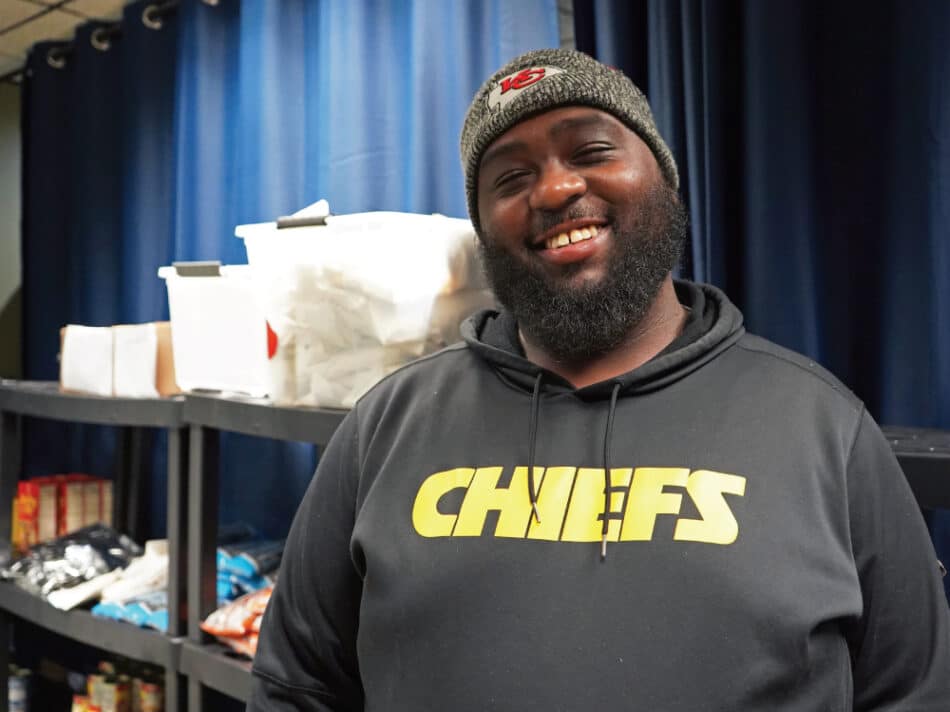
Andre may be a soft spoken man. But spend a few minutes with him, and a warmth begins to show—genuine, humble and powerful. It’s the kind of warmth you find in someone who’s fought hard for peace, and who’s determined to keep it.
Andre is a participant at the Second Chance Risk Reduction Center, a re-entry program designed to help formerly incarcerated individuals rebuild their lives with dignity, opportunity and support. Harvesters is proud to count them as one of our Agency Partners, as we help keep their on-site food pantry stocked for those in the program.
Andre’s story, like many others who come through the doors of Second Chance, began with the realization that something had to change.
“I went to prison about eight years ago,” Andre says, recalling the turning point of his journey. “Then I got out, and not long after, I got in trouble again. After that second time, I just started thinking, ‘I don’t want to keep going back to prison.’”
It was at that moment that Andre started searching online for different programs.
“Most people are referred by a probation officer or something,” he says. “But for me, it was different. I was searching. I was looking for direction.”
That search led him to Second Chance.
For Andre, Second Chance became more than a place to check boxes or attend classes. It became a space for transformation.
“It gave me support,” he says. “Fellowship. People I can be inspired by. We share stories. We motivate each other.”
The power of the program isn’t just in what it teaches—it’s in the community it creates. One where people many look down on are allowed to be themselves, to be vulnerable and to grow. Where they can acknowledge past mistakes without being defined by them.
“Second Chance helped me identify thinking errors,” Andre says. “Those little things that lead to big consequences. When you can correct your thinking, you can correct your path.”
Andre has taken part in vocational training, soft skills development, administrative certifications and even explored online learning through platforms like Udemy. The program provides tools, but more importantly, it helps people believe they can use them.
“There’s no pressure to leave by a certain date,” he says. “You graduate when you’re financially independent. When you’re ready.”
During this rebuilding process, food insecurity could have been yet another burden. But through the partnership between Second Chance and Harvesters, it hasn’t been
“Food may seem like a small thing,” Andre explains, “but when you’re trying to focus on big goals, it’s one less thing to worry about. Food insecurity affects a lot of people. Knowing there’s food here, it just helps you stay focused.”
Andre goes on to talk about how the convenience of having the pantry on-site reduces not only the stress of having food, but the stress of figuring out where to get it.
“If this pantry wasn’t here, I’d have to rely on church pantries,” he says. “But if you don’t have transportation, it’s tough. You’re walking with bags, hopping buses, spending hours. It makes everything harder.”
With Harvesters and Second Chance working together, Andre doesn’t have to make those choices between growth and survival. He can have both.
For all of Andre’s professional goals, his greatest aspirations are deeply personal.
“Family is big for me,” he says. “I have a daughter. I want to repair that relationship and be a consistent presence in her life. I want to give her what I didn’t have.”
He’s candid about his past. But because of the Second Chance, he’s no longer ashamed.
“Everybody makes mistakes,” he says. “Imagine if your mistake cost you ten or fifteen years. It happens. And a lot of the time, it’s because people didn’t grow up with what others take for granted—two parents, stability, guidance.”
What he wants people to understand is this: it’s not just about what someone did, it’s about what they do after.
“I’ve made mistakes,” he says. “But now I’m building something better. That’s what should matter.”
Andre hopes that sharing his story will help others—those afraid to ask for help, those caught in cycles of shame or fear.
“If you need help, ask,” he says. “There’s no shame in it. Second Chance, Harvesters—they’re here for people like us. People who want to do better.”