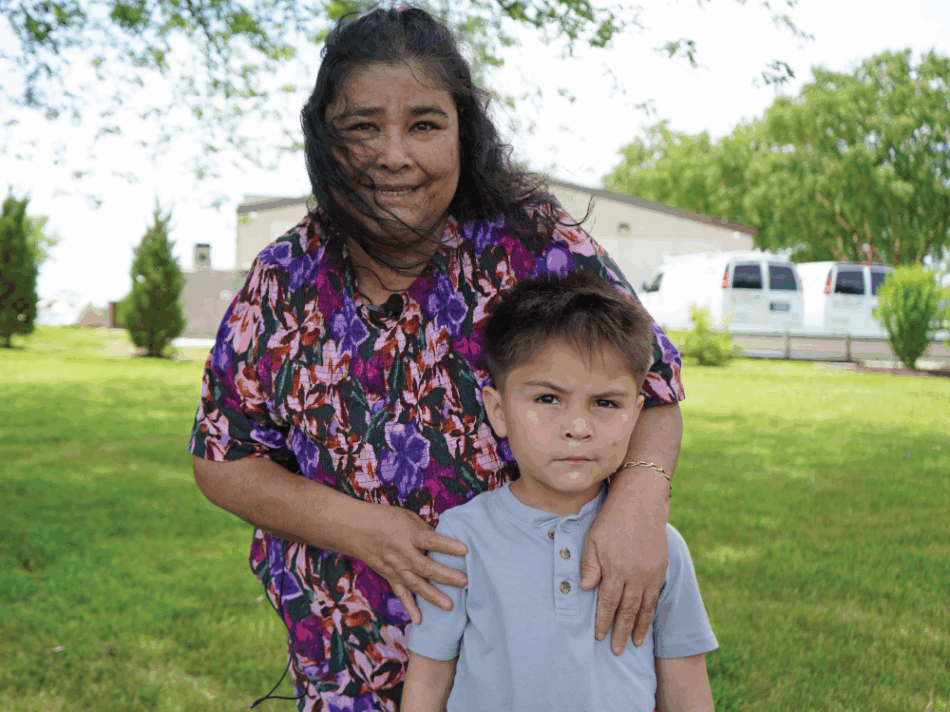
A stroke and degenerative osteoporosis has left Maria struggling to feed her family.
As her grandson plays with a stick under the shade of a tree on a hot summer day, her daughter waits in the line of cars at a mobile distribution set to begin at the First Baptist Church of Stilwell, Kan.
“I lost mobility from my shoulder to my elbow. Now, I can barely move my arm,” said Maria, a 52-year-old mother and grandmother who was interviewed in Spanish. “Sometimes, I can’t even do things around the house, bathe myself well or get dressed because of my arm, so if I need help my daughter helps me.”
No longer able to work or care for her three daughters, including the youngest who receives services for autism, Maria’s 23-year-old daughter quit college to help her mother and younger siblings.
For more than a year, the family has relied solely on her husband’s income. He pays almost $260 a week for medical insurance and funeral insurance “in case we need it.”
“If we need to pay a bill, sometimes we’re left with no money to even buy soap,” she said.
The fear of not having enough food has taken a toll on Maria’s mental health, as well.
“When there are times where that money isn’t there and you feel desperate — ‘What am I going to do?’ — depression kicks in because I also suffer from depression and anxiety attacks about what I’m going to eat or cook today.
“And when you have a daughter that gets home from school and says, ‘Mama, I’m hungry,’ and you say, ‘We don’t have food today…’ and your daughter turns around and goes to bed because there’s no food. That is difficult for any mom, I swear to you,” Maria says, wiping away tears with the back of her hand.
“The economy hasn’t been very good, so they told me about this place, and I started coming when my daughter started bringing me to the distribution,” she said. “It helps us a lot because they give away items that people have a hard time buying in stores, like fruits and vegetables.”
To make the food she receives last, Maria has learned to freeze any surplus for future meals.
“I can’t picture what it would be like without this assistance, because sometimes, like I told you, my daughter can’t bring me (to the mobile distribution due to her work schedule), but when she can, it is very helpful and I freeze what I can,” she said.
Maria is deeply thankful for the food she receives.
“You feel your mood go up when you receive this food. Like, finally, I have food! I have food in the refrigerator. I can take out the fruit they gave me. I can take out the vegetables and finally make something, because I love to cook,” she said.
Maria would like to thank Harvesters and the pantry volunteers who make it possible for her to access the food her family needs.
“I don’t speak a lot of English, but I always try to thank them and tell them that without them others would suffer more than they already do…without them we wouldn’t have food on the table,” Maria said. “I am really grateful for them from the bottom of my heart. Because of their goodwill, all of us have something to eat and we’re thankful.”