
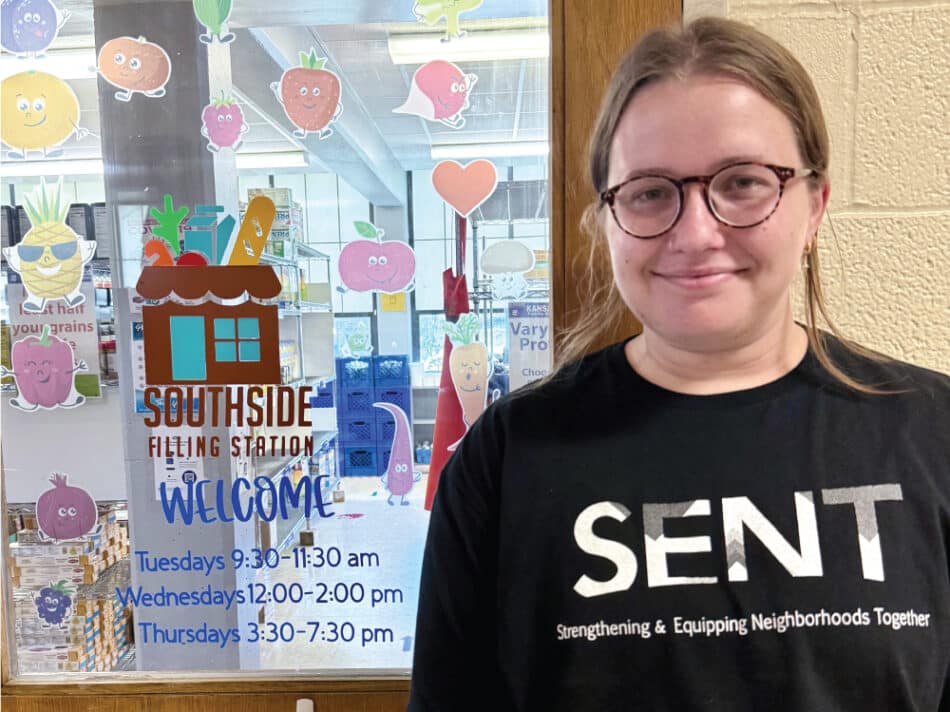
Since the pandemic, “there’s more need, and I think it’s only going to keep increasing. At the same time, I would say that our average monthly income has been increasing, and I’m trying to figure out why, if people make more money, they are unable to afford everyday expenses?” said Katie Roberts, SENT’s community liaison, who leads operations at the pantry. Roberts suspects the rising price of groceries plays a crucial role on the ability to pay for other critical, and often expensive essentials, such as healthcare and transportation costs.
“I had a woman come in today who said that she used the last of her gas to get here,” she said, “and I’ve heard that story from other people, too.”
As Southside Filling Station marks its first year in operation, it joins Harvesters’ network of 600 agencies distributing food in a 27-county region in Kansas and Missouri. The pantry is an outgrowth of SENT, a nonprofit fostering holistic community development in Topeka.
SENT is based on three pillars: community wellness, housing and education. The food pantry is part of the non-religious, nonprofit’s community wellness initiatives and provides a “funnel” for other social services, including substance abuse counseling. About 20% of the neighbors seeking food assistance at the pantry are unhoused or sheltered but without a permanent address.
“We have a lot of unsheltered people come in seeking food, and it takes on average 70 positive interactions to get them to agree to other services,” Roberts said. “Giving people food is not easy but it is the simplest way to have a positive interaction.”
Another group of neighbors in need includes seniors from Luther Place, a nearby subsidized housing complex. “Their weekly visits to the pantry have become their social hour,” Roberts said.
Families with young children also need assistance and volunteer their time. “Volunteers are allowed to shop the pantry when we’re done serving everybody. Most of our volunteers need the food, too,” she said.
Roberts, who started her career working in the foster system, is passionate about her new work and the pantry’s partnership with Harvesters, which supplies the bulk of their food donations.
“Even though I’ve never been through the struggles that these people are going through right now, I have always believed that food is a human right. It’s not a privilege. I guess I’ve been referred to as radical for thinking that, but I don’t think that that’s radical. I think that that should just be common belief,” Roberts said. “I just I want people to have their needs met, and I want people to improve their lives and, like, live good lives.”
Unfortunately, societal pressures can make it tough to ask for help.
“I think that stigma is there because people don’t understand how close they are to being in this situation at any given moment. You could have a car breakdown or an expensive bill, and I think that people need to realize that and humble themselves a little bit when they look down on people who utilize a food pantry and food stamps,” Roberts said.