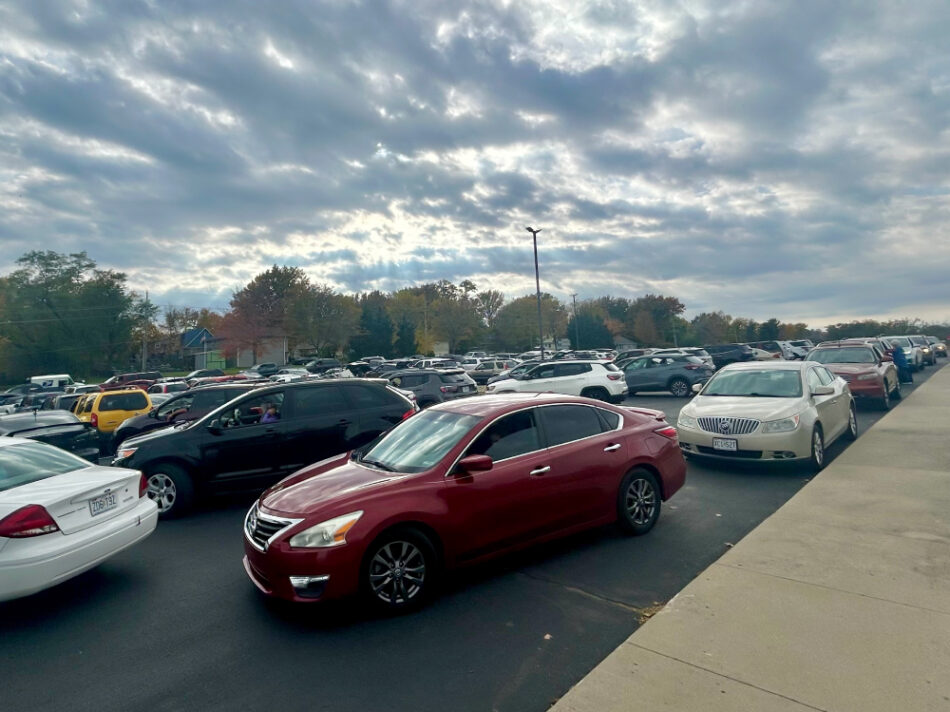
As a story collector for Harvesters and several other food banks around the country, I’ve visited dozens of mobile food distributions over the last several years. But this week (November 3-7), during the government shutdown, was vastly different. Here’s what I witnessed.
My co-worker, Jessica, and I went to a YMCA distribution in Olathe, Kansas, on Wednesday afternoon and arrived early like usual, but it felt really busy. There were about twice as many cars as normal waiting, with a constant stream pulling in. The YMCA staff were incredibly organized and kind, but were feeling the emotional weight of it all, we could tell. One volunteer told Jessica she was trying to work up the nerve to tell cars past a certain point there wouldn’t be enough food.
The director said they typically serve around 200 families and had estimated maybe 300 this time but the line never stopped after she made her estimation. Eventually, cars had to be turned away.
We rarely talk to first-time visitors during a typical distribution, but this time, roughly a quarter, maybe more, were new, which is highly unusual. Most said they were directly impacted by the SNAP shutdown.
At the community center in Holden, it was obvious they weren’t used to this kind of volume. They opened early because there was nowhere left for cars to park. I joined the outer edge of the volunteer meeting just before opening and listened while they were trying to figure out how to make the food stretch further.
I talked with a single dad in his late twenties who had never needed a pantry before. He’d lost his job and his son’s SNAP benefits and was now home caring for his sick mom who also lost access to other benefits because of the shutdown.
My co-worker and I tried to capture photos of the lines of cars, but it was difficult to get an angle that showed how massive the turnout really was. We needed to be on higher ground.
Our last stop was Cornerstone Church in Blue Springs, Missouri. The line was massive. They usually stage cars in the upper lot, register them, then move them down one by one to a lower warehouse area. This time, they had to extend the line from the lower lot all the way to the top. Eventually, they just opened early because there wasn’t anywhere else to put cars.
Almost everyone we talked to had been impacted by the SNAP shutdown in one way or another. One woman said she hadn’t needed a pantry in 10 years, but now her son’s group home, which relies on SNAP, can’t provide meals any longer, and her husband just lost his job.
This experience shows me the scale of need isn’t being communicated clearly enough in the media or by our politicians. It’s so much worse than I or probably anyone else expected. I saw way too many moms not sure how they were going to put food on their tables. What they were picking up via Harvesters was literally all some of them had. Their pantries and fridges were completely empty.
Matthew Slay
Brad Cecil and Associates