
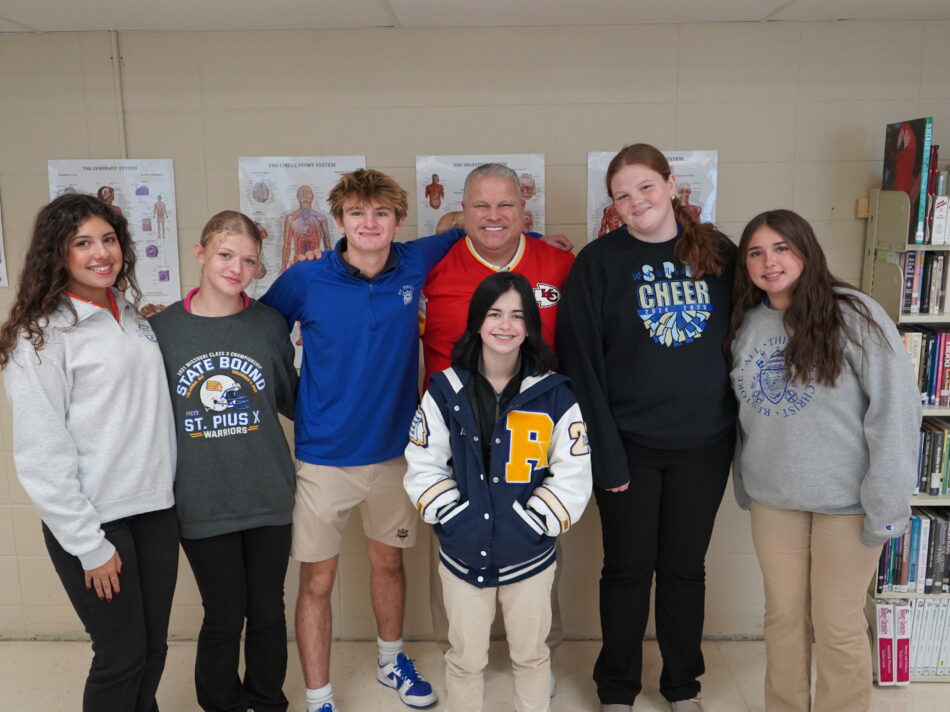
Frank Armato, a teacher at St Pius X High School in Kansas City, saw his life come full circle in recent years. Having graduated from that same school in 1986, he worked as an adjunct professor for about 15 years, teaching graduate school at Fort Leavenworth to troops transitioning out of the military into the corporate world in the MBA program. He then did another adjunct professorship at William Jewell College in Liberty.
However, Armato ultimately returned to St. Pius to not only teach Anatomy, but also to spearhead a dedicated Leadership class for interested Juniors.
At the heart of the class is the belief that leadership is less about authority and more about character. Armato emphasizes that while leadership is a widely discussed topic, it’s often conflated with displays of power rather than service.
Recently, Mr. Armato’s class paid a visit to Harvesters, where we put them to work on the vegetable line, sorting and packing produce that went out to our pantry partners in Kansas City.
One student, Luciana, described how eye-opening the experience was.
“I worked with different people, and it was in a food line where we had to box cans and nonperishable items,” she said. “We were talking about how we didn’t realize how many people don’t have food. Some of the food we were giving, we were like, ‘This would never be our first option,’ but it’s what people have. We realized one little thing we did could make a difference.”
Jonah, her classmate, reflected on the privilege of his own circumstances as well.
“We are a private school,” he said. “We’re on the good end of everything, and not everybody is. We’re one bad thing away from being in a situation like that. Since we are not, we need to help the people that are. I was packing apples. I have apples in my house all the time, but not everybody has that.”
For Armato, experiences like volunteering at Harvesters are essential to forming compassionate, servant leaders. He’s already planning additional volunteer partnerships with other area organizations like Catholic Charities, Hillcrest Ministries, the Salvation Army, and City Union Mission.
“We’ve learned that we have to represent what we try to lead,” said Jonah.. “If we just sat there and tried to tell people, ‘Hey, you should do this,’ and we don’t do anything, it just looks horrible. They’re not going to listen to you.”
Armato said that one of his main goals is showing his students that the best leaders do the most for other people and model how to replicate that mentality in other people.
“Leadership is probably the number one subject matter that’s written about,” he said. “But if you strip it down to its simplest terms, it’s modeling the way. It’s showcasing character, and trust. It’s listening authentically with humility. Anyone can say they’re a leader, but leadership is becoming a part of a group and rolling up your sleeves and becoming less and serving them.”
It seems that his philosophy has taken root. Jonah summed up his biggest takeaway from volunteering like this:
“No matter where you’re at—whether you’re a titled leader or just in the middle of it—you need to understand how to lead by example. Wherever I go, I just want to be able to help others.”